Commission-based SEO: how paying a share of your jobs works, who it suits and the risks
Commission-based SEO means you pay the SEO company a share of the revenue from the jobs your website brings in, in place of a large fixed bill every month. If the site books you nothing, you pay little or nothing. It works best when your average job is worth thousands of dollars. If your average job is closer to $200, a flat monthly fee is simpler for both sides. Either way, the deal only holds up when both sides agree in writing on what counts as a job from the site and who counts it.
Tenfold Local works with several companies on commission, so this is written from inside the deal. You will see how ours runs, what one of those sites has done, and the risks in plain view. Every outside number has its source at the bottom.
Key facts on commission-based SEO
- Only 2% of local SEO agencies and 3% of freelancers bill per lead. Per lead was the least used method among agencies in the survey, so you will have few offers to compare. (BrightLocal, Local Search Industry Survey 2023.)
- 63% of agencies charge a monthly fee for a set list of work. That is the retainer, and it is what most quotes you get will be. (BrightLocal, same survey.)
- None of the 20 SEO companies we read in Sacramento published a price based on a share of jobs. We do, and it is one of the few places you can get this deal without asking for a favor. (Tenfold Local check of each company's website, November 19, 2026.)
- A brick staining site we run on commission reached page 1 of Google in 7 new towns within 1.5 months of launch. Its first lead came 2 weeks after the site went live. (Bramwell-McKay case study, Tenfold Local.)
- 40% of small businesses that hire a marketing agency switch or drop it, and 60% of those blame a lack of return. A bill tied to booked jobs is one answer to that worry. (vcita survey of 500 US small businesses, 2025.)
- A share of a $200 junk removal job comes to $10 or $20. That is a lot of counting for a small sum, which is why small jobs fit a flat fee better. (Arithmetic at example rates of 5% and 10%. These are examples, not our rate.)
What this means for you
- Your job size picks the plan. Jobs in the thousands suit commission. Jobs in the hundreds suit a flat monthly fee.
- The contract matters more than the percentage. What counts as a job, who tracks it and who owns the website decide whether the deal is fair.
- You do not have to work it out alone. If you are not sure commission works for you, fill out the form or send us a note. We will look at your numbers, see what makes the most sense and go from there.
How does commission-based SEO work, step by step?
The company builds the website for little or nothing up front, then gets paid when the site books you work. Here is one month of it.
One month on a commission deal
- A customer finds the siteThey search your trade and town and land on a page.
- They call or fill out the formThe call goes through a tracked number. The form is logged.
- You get the listEvery call and form from the month, with the date and what they asked for.
- You mark what bookedWhich leads became jobs, and what you billed for each.
- The bill followsThe small fixed fee, plus the agreed percentage of that total.
What this means for you: two steps need trust. In step 2 you trust the company's tracking. In step 4 the company trusts your numbers. A fair contract says how each side can check the other.
How common is it to pay an SEO company by commission?
Rare. BrightLocal asked local SEO agencies and freelancers how they bill. 63% of agencies charged a monthly fee for a set list of work. Only 2% billed per lead, and 3% of freelancers did. The survey listed no option for a share of the client's revenue.
How local SEO agencies bill their clients
Share of agencies using each method. An agency could pick more than one.
We saw the same thing in one city. On November 19, 2026 we read the websites of 20 SEO companies that show up on Google for Sacramento searches. None published a price based on a share of the jobs a website brings in. One offered pay per lead on ads, with the price per lead not published.
What this means for you: most agencies you call will quote a retainer. If you ask one to work on commission and it says no, that is normal. The agency would be doing months of work before it sees much money. We take that side of the deal on purpose, because we have watched our sites bring in work early. The proof is further down.
Does commission make sense at your job size?
It does when a job is worth thousands of dollars, and it mostly does not when a job is worth a couple of hundred. The table shows why. It uses three example rates so you can see how the sum moves. They are examples. Our own percentage is agreed with each business in writing before we start, because it differs by trade and job size.
| Average job | Share at an example 5% | Share at an example 10% | Share at an example 15% |
|---|---|---|---|
| $200 junk removal load | $10 | $20 | $30 |
| $2,500 brush clearing job | $125 | $250 | $375 |
| $10,000 masonry or roofing job | $500 | $1,000 | $1,500 |
Source: Tenfold Local arithmetic. The rates are examples to show the sum. They are not our price or anyone else's.
What this means for you: on the top row, both sides would be tracking every call, matching it to a job and settling up over $10 or $20 at a time. A hauler doing 30 small jobs a month would report 30 of them. That is more bookkeeping than the money is worth, so for a business like that we charge a flat rate each month and keep things simple. On the bottom two rows, one booked job pays for real work on the site, and the deal makes sense for both of us.
What to do with this: write down your average job and how many jobs a month you could take from a website. If the average is in the thousands, ask about commission. If it is in the hundreds, ask for a flat price.
Who does commission-based SEO suit?
- A trade with large jobs. Brush and land clearing, masonry, roofing, tree work, remodels. One job from the site covers a month of work on it.
- A new business. You have no spare $1,000 for setup and no proof yet that a website will pay.
- A seasonal trade. A dead month costs you the small fixed fee and nothing more.
- An owner who has paid an agency and seen nothing. I paid agencies thousands a month for results I could not see. A bill tied to booked jobs would have ended that fast.
It suits you less if:
- Your jobs are small. At $200 a job, a flat monthly fee is easier to run and easier to budget. That is the plan we would point you to.
- You want to own the website from day one. The company has paid to build the site, so expect it to own the site while the deal runs. Ours does, and it becomes yours later.
- You do not want to report your job totals to anyone. The deal cannot run without them.
- Your leads already come from referrals. Those are not commission jobs, and a new site may add little at first.
What are the risks of paying a share of your jobs?
There are five, and each one can be closed with a line in the contract.
- Tracking you cannot see. If only the company sees the call log, you are paying on its word. Ask for the same list it bills from, every month.
- A loose meaning of "a job from the site". A neighbor refers a customer, who looks you up and calls the number on your site. Is that a job from the site? The contract should answer cases like that one. Referrals, repeat customers and your other ads should be named as yours.
- Who decides when you disagree. You say a lead never booked. The company thinks it did. The contract should say what records settle it, such as an invoice.
- The website is not yours yet. The company paid to build it, so expect it to own the site, the domain and the tracked phone number while the deal runs. Ask what it costs to take the site with you, and after how long it is yours.
- The fee grows with you. The better the site does, the more you pay. Ask if you can move to a flat fee later, and at what price.
What to do with this: turn the five into questions and ask them before you sign. If an answer is not in the contract, ask for it to be added.
How does it compare with a retainer, pay per lead and a rented website?
Each one puts the risk in a different place. The table shows who is carrying it.
| Way to pay | What you pay | Who carries the risk | What you keep if you stop |
|---|---|---|---|
| Commission (a share of jobs) | A small fixed fee plus a percentage of the revenue from booked jobs the site brings in | Mostly the SEO company. No jobs, almost no pay | Depends on the contract. On ours, the site after 12 months, or for $500 sooner |
| Monthly retainer | The same fee every month. In Sacramento, published prices start between $500 and $2,000 at six of ten companies | You. The bill comes whether the phone rings or not | Depends on the contract. Ask who owns the domain and site |
| Pay per lead | A price for each call or message. About $49 a lead for junk removal on Google Local Services Ads | Shared. You pay for leads that do not book | Nothing. The leads stop when you stop paying |
| Rented website | A low monthly subscription with no setup fee. One Sacramento company advertises "as little as" $245 | You, but for a small amount each month | Ask. The pages we read did not say who owns the site |
Sources: Tenfold Local price check of Sacramento SEO companies, November 19, 2026, and our own service terms. Lead price from 99 Calls, a company that runs Local Services Ads, from three of its client accounts.
What this means for you: commission is the only row where the SEO company goes unpaid when the site brings nothing. That is the reason to ask for it when your jobs are big enough. A retainer is fair when you can see the work and the calls. Pay per lead is fair when the leads are real and yours alone.
We compare the cost of each in what SEO costs in Sacramento.
How do our own commission deals work?
We work with several companies on commission. Each one pays a small flat rate every month, usually under $100, which covers part of our ongoing monthly costs. On top of that we take a percentage of the revenue from the jobs the site brings in. The published version is our Results plan: $96 a month plus a percentage of the revenue from the jobs your site brings in, with no setup fee. We agree the percentage with you in writing before any work starts.
From there we are more like partners than a vendor and a client. We only do well when the site sends you paying work, so every hour we put in is aimed at that.
How we get paid. We run a tracking system on the site. It logs the calls to the site's phone number, every form that is sent, and how each person got to the website. At the end of the month both of us can see which leads came in and where they came from. You tell us which ones closed and what you billed, and the commission is worked out from that.
It takes trust on both sides. We are trusting you to be forthcoming about the jobs you closed. You are trusting us, because we hold the keys to the website. So we put the answers to the five risks in writing.
- Tracking. We track every call and form and share the list with you each month.
- What counts. A job you book with a customer whose first contact came through a call or a form on the site we built. Referrals, word of mouth, repeat customers you already had and your other ads do not count.
- Disagreements. You mark which leads booked and what you billed. We run our own tracking and may ask for an invoice for a lead on the list.
- Ownership. We own the site, its domain and its tracked number while the plan runs. In the first 12 months you can take the site for $500. After 12 months it is yours at no charge.
- Growth. Our flat plan is $390 a month with a $1,000 setup fee. If you think you will want to move to it later, tell us before you sign and we will put the terms of the switch in writing.
There is one hard line. If we find a job hidden on purpose to skip the commission, the deal ends and the site stays with us. The full wording is in our service terms, and the plans are on the pricing page.
What has a site on commission done?
Ask any company that offers this deal for a result from a client on it. Here is one of ours. Bramwell-McKay is a family masonry company in Indiana. We built it a website just for brick staining, on a custom deal based on commission.
Bramwell-McKay, a site we run on commission
Brick staining, Indiana. The company had no presence in these seven towns before launch.
- 2 weeksfrom launch to the first lead, through the form on the new site
- 1.5 monthsfrom launch to page 1 of Google in all 7 new towns
- #1on Google by month 3
- #1 of 3companies ChatGPT named for "best brick staining company in Indiana"
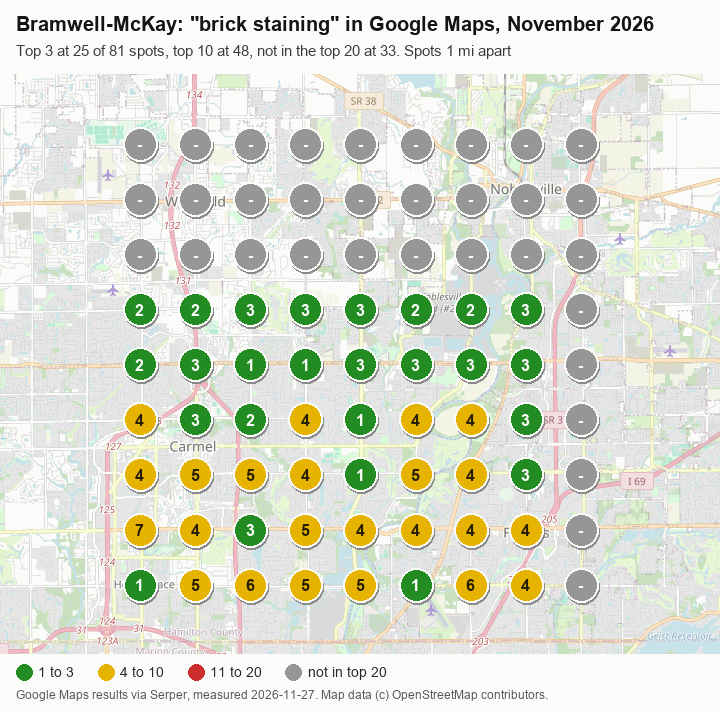
What this means for you: a company that is paid on your jobs has every reason to get the site ranking fast. This one did. Three more sites, with their dates, are in our case studies.
What to do before you sign a commission deal
- Work out your average job. Thousands points to commission. Hundreds points to a flat fee.
- Ask the five risk questions and get the answers into the contract.
- Ask for a result from another client on the same kind of deal.
- Ask what happens if the site books nothing for six months.
- Get a flat quote from the same company and compare the two.
Not sure which way your numbers point? Fill out the form below or send us a note. We will take a look, see what makes the most sense for your business and go from there.
Sources
- BrightLocal, "What should my agency be charging for local SEO?", citing its Local Search Industry Survey 2023. Checked November 19, 2026.
- vcita, survey of 500 US small businesses, released July 15, 2025. Checked November 19, 2026.
- 99 Calls, Local Services Ads cost per lead by industry. Checked November 19, 2026.
- Tenfold Local, check of 20 Sacramento SEO company websites, November 19, 2026, our own service terms and the Bramwell-McKay case study.
To cite this page: Tenfold Local, "Commission-based SEO: how paying a share of your jobs works," tenfoldlocal.com/blog/commission-based-seo.
Want help with this? Book a free call
It is 30 minutes, on the phone, and free. We look at your website and your Google listing together, and I tell you what I would fix first and in what order. If you want me to do the work and get you ranked, we can talk about that. If not, the plan is yours to keep. No pitch.