How to rank #1 on ChatGPT: we asked it 39 times who to hire
The short answer: ChatGPT does not keep its own list of good contractors. When someone asks it who to hire, it searches the web, picks from the businesses Google already shows, and reads their websites. So you get named first by doing five things, in this order. We know because we asked it 39 times and checked every company it named.
How to be the company ChatGPT names first
- Get on Google's mapBe one of the first 10 businesses Google shows for your trade.
- Own a websiteWith a page for each job you do.
- Show your licenceNumber on the site, clean state record.
- Collect reviewsAsk every customer, every job.
- Match your detailsSame name and phone everywhere.
What did we test?
We asked ChatGPT one question 39 times: "Who is the best plumber in Modesto, CA?", then the same for 12 more trades, in Sonora, Modesto and Sacramento. It named 1 to 3 companies each time, 85 in all. Then we looked up every one of them on Google. No one can promise you the first spot. But the answers show how ChatGPT chooses, and that is what the five steps are built on.
Step 1: get into the first 10 businesses on Google's map
Why: that is where ChatGPT found most of its picks. The map is the box of local businesses with stars near the top of Google. Of the 39 companies ChatGPT named first, 33 were among the first 10 on Google's map for the same trade and town. Only 6 were not.
Where the company ChatGPT named first sits on Google's map
39 answers. Same trade and town searched on Google.
Good news in that chart: you do not have to be number 1 on Google. ChatGPT named Google's number 1 first only 10 times. It named a business from spots 2 to 10 first 23 times.
How to do it: search your trade and your town on Google and tap "More businesses". Count where you are. If you are not in the first 10, finish your free Google Business Profile: the exact category for your trade, every service, every town you work. The local SEO checklist walks through the profile step by step.
Step 2: have your own website, with a page for each job you do
Why: your website is what ChatGPT reads and links. In 37 of the 39 answers it linked a company's own website. It did not link Yelp or Facebook once, even though Yelp was on the first page of Google for every one of these searches.
What ChatGPT linked in its answers
Out of 39 answers. One answer can link several places.
And it picks by the job. We read the reason ChatGPT gave for each of the 85 companies. The most common reason, 36 times, was a kind of work: "brick repair or repointing", "wood fencing", "full yard redesign". Reviews were the reason 18 times. ChatGPT can only match you to a job if your website says you do that job.
How to do it: give each service its own page, named the way a customer says it. "Water heater replacement", not "our services". A home page with 12 services in one line gives ChatGPT nothing to quote. Do the same in the first lines of your home page: "Serving the Mother Lode with quality service" tells an AI nothing, while "Brush clearing in Sonora, Jamestown, Columbia and Twain Harte" tells it what you do and where. More on how AI tools choose is in what AI search means for local trades.
Step 3: put your licence number where it can be found
Why: ChatGPT checks it. In 21 of the 39 answers it linked California's Contractors State License Board, the public site where anyone can look up a contractor. In 26 of the 39 it talked about the licence.
How to do it: put your licence number in the footer of every page of your website. Then look yourself up on the licence board's site. Make sure the record is active and the business name matches the name on your website and your Google listing.
Step 4: ask every customer for a Google review
Why: ChatGPT goes looking for reviews before anything else. Every one of the 39 answers started with a web search that had the words "best" and "reviews" in it, such as "best electrician Modesto CA reviews". And 37 of the 39 answers talked about reviews or star ratings.
How many do you need? It depends on the size of your town. This is the middle number of Google reviews among the companies ChatGPT named.
Google reviews of the companies ChatGPT named
The middle company in each town. Half had more, half had fewer.
Do not let a big number stop you. Of the 63 named companies we found on Google's map, 19 had fewer than 50 reviews.
How to do it: text the review link to every customer the day you finish the job.
Step 5: make your name and phone number match everywhere
Why: ChatGPT hands the customer your phone number. 29 of the 39 answers gave one. It pulls details from your website and from review sites such as Birdeye, Angi and the BBB. If one of them has an old number, that can be the number a customer gets.
How to do it: search your company name with the word "reviews" after it. Open every result. Fix the name, the phone number and the town on each one so they match your website. Put your phone number on every page of your site as text you can tap.
How do you make sure ChatGPT can read your site?
The five steps are what ChatGPT looks for. This is the setup behind them: what we did on my own company's site and on our clients' sites so that AI tools can find and read every page. Most of it takes an afternoon.
1. Register your site with Bing, not only Google
Why: ChatGPT does not search with Google. OpenAI's own help pages say ChatGPT can send its searches to Bing to get web results. Most owners set up Google and never touch Bing.
How to do it: open Bing Webmaster Tools. It is free. Choose "Import from Google Search Console" and it brings your site and your page list across in one step.
2. Check that every page is indexed
Why: an AI tool can only quote a page that a search engine has found and stored. That is what "indexed" means. A page that is not indexed does not exist as far as search goes.
How to do it: open Google Search Console and look at the Pages report. It lists every page that is not indexed and says why. Fix those, and ask for indexing each time you add a page. Google says a page only needs to be indexed and able to show in regular search to appear in its AI answers: "There are no additional technical requirements."
3. Add two small files: robots.txt and llms.txt
robots.txt tells search engines and AI tools what they may read. Make sure yours does not block them. OpenAI's search crawler is called OAI-SearchBot, and OpenAI's page says a site that blocks it "will not be shown in ChatGPT search answers." To check, type your web address and add /robots.txt to the end. Look for the word "Disallow" next to names like GPTBot, OAI-SearchBot, ClaudeBot or PerplexityBot. Some website builders and security tools block them by default. If you see that, ask whoever runs your site to allow them.
llms.txt is a plain summary of your business for AI tools: what you do, where, and your prices. To be straight with you, no AI company has said it ranks sites by this file, and Google has said its Search does not use it. We add it because it takes an hour and puts your facts in one place.
4. Write pages that answer what people ask ChatGPT
Why: people ask ChatGPT full questions. "Who is the best at this in my town?" "What does it cost?" "Who should I call?" In our test it matched companies to jobs by what their pages said.
How to do it: write one page for each question your customers ask. Answer it in the first two lines. Then add details from a real job: the town, what made it hard, about what it cost.
5. Get listed with the BBB and your Chamber of Commerce
Why: ChatGPT reads these. It linked the BBB in 4 of the 39 answers. In one of our extra questions it pointed to a company's county Chamber of Commerce listing as a reason to trust it.
How to do it: claim your BBB profile and join your local Chamber. Use the same name, phone number and town as on your website.
Can you do this on Wix, Squarespace or GoDaddy?
Some of it. The site builders have added a few of these controls. Wix, for example, lets you edit robots.txt and makes an llms.txt for you. Where a builder gets hard is the rest: a separate page for every service and every town, full control of what each page tells a search engine, and pages that load fast on a phone.
That is why we build custom sites. We use AI to build them, and we have done it enough times to have a system. A custom site used to cost thousands of dollars up front. On our Results plan the setup fee is $0. The plans are on the pricing page.
Is it easier in a small town?
Yes. In a small town ChatGPT mostly names the same companies Google's map shows. In a big city it also names companies the map does not show first, so a clear website is a second way in.
| Town | Companies ChatGPT named | How many were also in the first 10 on Google's map |
|---|---|---|
| Sonora | 28 | 24 |
| Modesto | 28 | 24 |
| Sacramento | 29 | 15 |
Source: Tenfold Local ChatGPT test, November 15, 2026. 13 questions per town.
Can anyone guarantee you the first spot on ChatGPT?
No. ChatGPT gives different people different answers, and it changes from one day to the next. In 15 of the 39 answers it asked what the job was before it would settle on one company. Be careful of anyone who sells a guaranteed spot. Skip two other shortcuts too: Google says no special code is needed for its AI answers, and that made-up mentions, such as paid posts that name-drop your business, do not help.
There is no guarantee, but there is a method. The five steps are not a one-time job. They are things you keep doing.
- Every week: write up one real job as a new page on your site. Where it was, what made it hard, about what it cost. And ask that customer for a review.
- Every month: add or improve a service page or a town page. Check that your Google listing, your licence record and your review profiles still match your website.
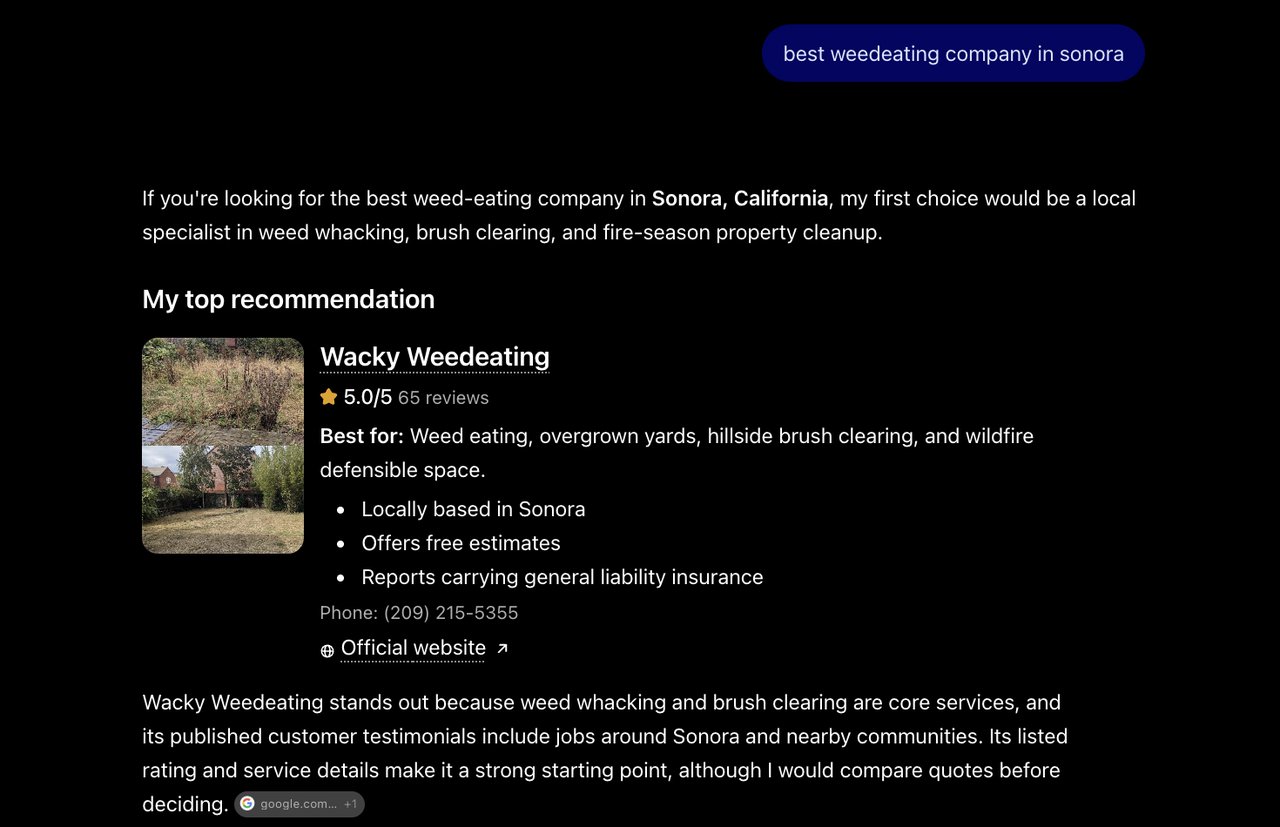
We know the method works because we ran the same test on our own work. We asked ChatGPT who the best company is for weed abatement, for weed eating and for brush clearing in Sonora, CA. All three times it named my own company, Wacky Weedeating, first, and it linked our own pages. For brick staining in Indianapolis, Bramwell-McKay, a site we built, was one of the two companies it named. The dates and screenshots are in the case studies.
This weekly and monthly work is what Tenfold Local does for its clients. We build the site, turn your voice notes about real jobs into new pages each month, and keep your details matching. You run the jobs.
It takes months, not weeks. An AI can only name what it has already read, and new pages take time to be found. On my own company's site we published about one article a week. It reached #1 on Google at about month 3, and by about month 6 customers were telling us they found us by asking ChatGPT or Gemini. One company in one town is a small sample, so take that as a pace, not a promise.
Check yourself in two minutes
- Open ChatGPT and type: "Who is the best [your trade] in [your town], CA?"
- Are you named? If not, write down who is, and which websites it links.
- Search the same trade and town on Google. Are you in the first 10 on the map? If not, start at step 1.
- If you are on the map but ChatGPT skipped you, open your website. Is there a page for the job you want? Is your licence number on it? Start at step 2.
Run the same check on the first of every month and write down the answer. And ask every caller how they found you. "I asked ChatGPT" is an answer we now hear.
If you want a second set of eyes, book the free call below and we will ask ChatGPT about your company together.
How we ran the test
- 39 questions on November 15, 2026: "Who is the best [trade] in [town], CA?" for 13 trades in Sonora, Modesto and Sacramento.
- We asked through OpenAI's developer service, using the model gpt-6.1-sol with web search turned on and the location set to each town.
- We listed every company each answer recommended, in order, and matched them by name to the first 10 businesses on Google's map for the same trade and town, collected November 13, 2026.
- We do not name the companies, except our own.
- The same day we asked eight more questions the same way about the kinds of work our own clients do, in Sonora, CA and in Indiana. Wacky Weedeating was named first in three. Bramwell-McKay was named for Indianapolis and not for the statewide question. Two sites launched in October 2026 were not named yet.
Limits: this is one day, three towns and one way of asking. ChatGPT's answers vary from one try to the next, and the phone app can answer differently from the developer service we used. Companies were matched by name, so one listed under a different name on Google counts as not found. The test shows who was named. It cannot prove why.
Sources
- Tenfold Local, ChatGPT test, 39 answers, November 15, 2026.
- Tenfold Local, California state study, Google results for the same trades and towns, November 13, 2026.
To cite this page: Tenfold Local, "How to rank #1 on ChatGPT: we asked it 39 times who to hire," tenfoldlocal.com/blog/how-to-rank-number-one-on-chatgpt.
Want help with this? Book a free call
It is 30 minutes, on the phone, and free. We look at your website and your Google listing together, and I tell you what I would fix first and in what order. If you want me to do the work and get you ranked, we can talk about that. If not, the plan is yours to keep. No pitch.